Showing posts with label Fast and Loose. Show all posts

Saturday, 18 February 2012

What Do We Actually Want From Improv On Television?

Jules Garnett works in film production, has improvised regularly with Friendly Fires and Ludus Ludius, and is currently creating an improvised karaoke show.

Let’s face facts: television may be considered culturally passé by many, but it’s still an incredibly effective means of gaining exposure. If something is on television, it’s in the public consciousness, and is thus elevated elsewhere.

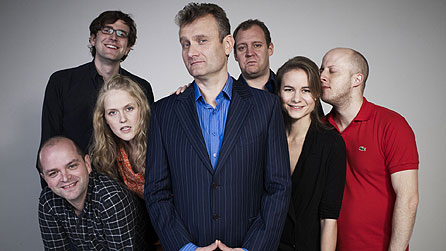
There have been two major attempts at improv formats on British television recently: the BBC’s ‘Fast and Loose’, and Dave’s ‘Improvisation My Dear Mark Watson’. Both were fairly strongly rejected by the improv community. I don’t want to waste time with what I consider to be the failings of these shows (save to say that the name of the latter is abysmal), but for a number of reasons, they weren’t considered successes by us talk-backers.

Now, the BBC is taking another crack at it with ‘@cuff’. My feeling from reading the synopsis (for what little it might be worth) is that this show looks well cast, but the gimmick of tweeting/updating suggestions reads like a desperate attempt at appealing to a young, net savvy crowd. I hope it’s better than that would suggest, but I’ve been in enough pitching sessions to know where these things come from.

Regardless, I have to wonder what the improv community actually wants to see from television improv. In essence, how do you want the form represented?

More specifically:
Does it matter that content reflects the types of things happening in clubs/theatres?
Should it try to be new/different/experimental, or is it okay to do the same types of things that have been done before, as long as they’re done well?
Does it matter whether short form (much more typical for television) or long form is represented?
If long form, does it matter whether it’s single-suggestion uninterrupted (Harold shows,’ Music Box’, etc) or called/directed (‘Showstopper’, ‘Lights, Camera, Improvise’, etc)? Does it matter whether it’s narrative driven, or consistent of thematically linked scenes?

I’m more interested to find out what you think (and if there’s any consensus) than prescribe my own doctrine, but I will say one thing about originality. I watched GSN’s ‘Drew Carey’s Improv-A-Ganza’, and tired of it pretty quickly. It wasn’t that there was any issue with the quality of the show’s content, but I felt that I’d just seen it all before. The fact that there was a bigger cast and a drunken audience didn’t seem to make a lot of difference.

I’d like to treat this as something of an online think tank, so please discuss below and we’ll get to the bottom of this.
Grooves,
Jules

-----

Tuesday, 13 September 2011

Television And Improv Sittin' In A Tree, Engaged In An Endless Series Of Mutual Misunderstandings

Did I really say that TV is dead? (yes, here) It sounds like the sort of sweeping statement I might steal from somebody smarter than I and then pompously pass off as my own.

Was I right? I don't think so, but I was probably in a bad mood. TV isn't dead, I work there for a start. My monthly salary is testament to its continued vitality. I suppose that I do view most of my traditional televisual content via the iplayer or similar mechanism. I rarely allow the tyranny of TV scheduling to rule my viewing habits. But I am not the nation and while there is a significant shift in how the UK (and beyond) consumes its TV content, TV is still the vector of choice for most. For now.

I think the point I may have ballsed up making was that we live in an age where TV companies aren't a requirement for making content now. Cheap cameras and youtube have opened doors for us all and recent shows like Felicia Day's The Guild are ideal examples of things we don't need a network for. Anyhow.

Jon makes some observations about TV's relationship with improvisation. I agree, it's a poor dynamic. Why do TV and improv seem such poor bedfellows. Let's look at a recent example. I have worked with many of the performers who participated in the BBC's Fast And Loose and know them to be daring, smart and funny improvisers, I was disappointed to see that they seemed very restricted by the format of the show. Now, I understand why those restrictions were put into place by the producers over the development process. Or I think I do, and isn't that the same thing? (On the Internet? Yes.)

Let us compare, in broad terms, the production process of a stage improv* show in London and that of a TV improv show (which might look like I'm talking about Fast and Loose, I'm not, I don't know much about the production process of that particular show. I speak in broad generalities).

The stage improv show might cost anywhere between £0 and £100 to put on for a night, depending on your venue, publicity costs, cast-subsidised T-shirts et al. What's the worst that can happen? If you get no audience, you're out £100 and an evening. If you have a bad show, you're probably not getting that crowd back again, but there's plenty more fish in your facebook group. You can put on another show, happy that your company's brand hasn't taken much of a hit. Good. This is how it should be, people should be putting on new improv shows and trying new stuff all the time, because the cost of failure is minimal or non-existent.

Now, TV. Well, you're gonna need a venue, that means a studio and cameras, plus people to operate the cameras, a director and gallery staff, someone to manage them. You'll need a warm up guy for the audience, floor managers to wrangle them and the talent. Of course, you'll need talent, at least one of whom is a "name" because the company needs as many selling points as possible. You need to rehearse the format, same as you would for a stage show, only this time you're paying people to do it. You've got to design not just a logo, but then get front and back title sequences made, plus theme music as well as stings, beds and more for mid show. Then there's the graphics for the show, the astons and animations, they need designing and building, so does the set and the storage costs for your equipment. Now at this point, I have no idea how much you've spent. But I'll bet we're somewhere over £100,000. (Does my argument fall down because I don't have actual figures? If you think it does, replace my speculative number with the phrase "a huge amount of money", thanks). That done, that money spent, how do you make sure your show isn't shit? It's improv, right, that's always a risk, you could have a bad show tonight. What's the worst that could happen? Well, let's say the TV show has a bad night, 2-3million people watch it, some of them don't come back, you get bad reviews in the press, you're the guy who spent £100,000 on a lemon. You're the guy whose boss wants to know how we make next week's show good.

You're a producer, not an improviser, so that's just a worst case scenario. You're already in a position (important phrase coming up) to demonstrate that you have put practical measures into play to prevent the show tanking. The important word is demonstrate. These measures don't have to work, but they have to look like they would have done. It's like maths, you may not get the right answer, but if the working in the margin looks good then you'll get some marks. Here's some of the measures I've heard reports of producers from around the world consider to tighten up improv ideas:
  • What if we pre-improvise the scenes, that way we can pick the good ones and perform them on the night?
  • Games are funny, so a bunch of games at the same time must be funnier. Funny's exactly like numbers right?
  • Maybe each show could be about three hours long and we'll edit together the best 27 minutes?
  • I like the guessing game, that never gets old. Why don't we just do that over and over.
  • Maybe the audience suggestions are too weird, why don't we prep funnier suggestions and set-ups?
  • These improvisers aren't working, lets get stand-up comedians to replace some of them. Those guys get lots of laughs.
Remember if you are a producer with an idea (good or bad) that someone else has come up with and you're not fucking with it in some way, you're not producing right.

That's my diatribe done with. I understand the two main reasons why Fast and Loose wasn't the show I wanted it to be.a, I wasn't in it** and b, it was produced by producers.

Which brings me to my main point, the cost of failure for a TV production company and an improv troupe are vastly different, almost opposites. Our stage show? If we fuck that up, who's gonna care? About twelve people? The TV show has huge amounts of time, money and energy invested in it and it's going to be seen by a lot of people. Its failure has significant consequences for everyone involved and I swear, to the producer who just wants to make good TV, it looks like these procedures help.

In short, I think improv will continue to have a tricky time on TV, until TV execs learn more about the nature of improv itself. Maybe that time will come? We may have to just keep making these shows, each iteration with a little less control and a little more freedom for the casts until a company is eventually persuaded to take a more substantial risk. I'm not holding my breath. But why do so many improvisers seem to really want there to be a TV improv show? Answer me with opinions and words please.

*I unwaveringly use the term "improv", if this bothers you because you prefer "impro" I would ask you to ignore the "v" and never explain to me the reasoning behind your preference.
**And if I was, you can trust I'd be doing whatever I was asked by the producers, I need money.

(Also, one tiny afterthought, while Drew Carey is far from the world's greatest improviser, I doubt he stole "Improvaganza" from my beloved RFT. There's a finite number of good improv-puns out there, I used Improvaganza in the past before I'd heard of Edmonton and the good work that goes on there. I am as guilty as he.)

Foxcroft
(Edited - 15/09/2011 to remedy my own grammatical inadequacies)

Monday, 12 September 2011

Why Are We Pursuing A Tired Old Medium?

I'm glad there's nothing good on the box; it'd really cut into my comedy time.

'Whose Line is it Anyway?' was brilliant though, wasn't it? I spent many hours laughing at the likes of Greg Proops and Josie Lawrence making up some of the best comedy on TV in the 90's. And if you watch the repeats they are still brilliant, still standing up to the test of time. That's pretty rare; I was bored of 'Little Britain' after 3 episodes, but I suppose that's what happens when you do the same episode for three series' instead of making new stuff up for every show.
I digress (already).

Many's an hour been spent in conversation with fellow improvisers about how we could get a decent British improv show on our telly-boxes again. We thought we might get one earlier this year, but were sadly disappointed by the beeb. And more recently Channel Dave followed in those never-to-return-for-a-2nd-series footsteps. Still, the question is asked: How do we get a good impro show on telly?

The US has had some success quite recently. 'Drew Carey's Improvaganza' did well (despite stealing the name from Rapid Fire Theatre), but that's been cancelled now. If you include shows like 'Curb Your Enthusiasm' and 'Reno 911' you COULD say improv is almost mainstream over there. Almost.
And if you DO include those, then you could consider 5% of 'Outnumbered' was a fairly good British impro show.

But we're still losing comedy airtime to 'Mrs. Brown's Boys', so it's not going that well.

I was having a chat with Paul Foxcroft (Horse Aquarium) a while ago. He said something rather sensational but worth a nod,

"TV is dead."
- Paul Foxcroft


I thought then about when was the last time I actually regularly watched the expensive black rectangle in the corner of my lounge.
Ummm.
He was right, y'know. Apart from the occasional iPlayer catch-up of Dr Who, and the even fewer times when I remember I've downloaded the latest cool HBO series - my TV lays dormant at the edge of the room. If anything, I'm usually out anyway: rehearsing, watching or performing shows preferably.

Watching a show live on stage is rarely a completely bad choice. There's unbelievable amounts of good stuff out there, impro and other (lesser) stuff. And it's not even always expensive (London Improv nights are a fiver, as a rule).

Even if you accidentally end up at a bad show (eg: at the Dominion theatre), it's likely a social experience that you can laugh about afterwards with friends. A totally shite show can spawn the most joyful of discussions, and give you some valuable lessons about your own performances. Winner.

So I've given up on the idea of TV impro. Unless there's an influential, energetic, maverick producer out there willing to take the time to understand improvisation as an artform, it's a fruitless pursuit. And in a world where execs would rather commission another series of 'A Bunch of Morons Applying Fake Tan' it's highly unlikely.

The joy of impro is on the stage, so that's the thing to focus on. It's already going on pretty much every night (London-centric, sorry) if you look for it. I don't need to sit through half an hour of 'Fast And Loose' to watch Ruth Bratt or Dave Reed be stifled by oppressive producers, I can just go and see them play with glorious freedom in real life, and I get much longer in their company too. It's really very superior. A lot.

Unless it's from someone who cares about improv, the telly will continue to falter in it's pursuit of a successful improv show. And I'll join the legions of passionate improvisers who switch off in disappointment.

And that's coming from someone with a really nice telly, too.

(He says, blowing dust off an X-box.)

- Jonathan Monkhouse

Saturday, 15 January 2011

Slow and Tight

So Fast and Loose happened. Impro is finally back on mainstream TV, at least for 8 weeks anyway. We had an impro-watching party around the main event, watched some made-up-on-the-spot telly such as Curb Your Enthusiasm and Reno 911, and we watched some YouTube clips of brilliant groups like Beer.Shark.Mice and the amazing Upright Citizens Brigade (video below). which were all magnificent, but by far the central reason for our evening was Fast & Loose.

There has not been a mainstream British impro TV show since Whose Line Is It Anyway? about 15 years ago, so the expectations amongst the impro community could be felt like a build up of silence before a tidal wave hits...

So did the wave hit with the full force of a 15-year surge and a burgeoning contemporary impro scene? Well, um,... -ish... sort of like... sort of.

The twitterverse was lit with swathes of commentators. I would say it was mostly positive. Interestingly, the good complimentary stuff seemed to come from the 'normal' TV viewer. Lots of people thought it was hilarious. That is great. The dissenters, however, appeared to be people from within the improv community. There was a noticeable voice from improvisers all over the country that was disappointed and unsatisfied.

I am mixed. I thought the show was okay, but felt very calculated and safe. One if the most joyous aspects of doing impro is that the audience call out suggestions. This does two things:
1. proves that it's improvised.
2. gives the improvisers completely bat-shit crazy unexpected suggestions to work with.
There was no audience interaction whatsoever on Fast & Loose. Why the hell not? They managed it 15 years ago with Whose Line? so why take a backwards step now?

The cast list included Pippa Evans and Humphrey Ker. These are two perfectly decent improvisers who could cope with any suggestion the audience could muster. Future cast members for the series include Ruth Bratt and Dave Reed, who are also off-the-cuff masters. The Fast & Loose decision-makers are happy to use less-well-known but entirely capable improvisers, but it appears that due to some wet fear of risk-taking they also had to go down the danger-free route of stand-up comedians and a fail-safe format. The name of the show ended up being quite the opposite of the truth.

My lady-cohort observed that if you wanted to broadcast a show about mime, you would go and talk to some mime artists; find out if there was a community of people who do mime and which performers those mime artists respect most. You would work with those maestros to form the best mime format you could for your TV show and the best mimists for your cast.

Why then, didn't Fast & Loose work more with prominent people in the improvisation circuit? There are people out there who've practiced incessantly on the art of improv for years and years and are regarded as figureheads in the community. Dylan Emery is one of the creators of Showstoppers, performs in Grand Theft Impro, runs the Crunchy Frog Collective, part of the astounding School of Night and is well regarded as a bit of a powerhouse in making existing improvisers work harder and be better since he took up the mantel that Alan Marriott left behind when he moved back home to Canada.
Steve Roe almost single-handedly runs Hoopla! and you won't find anyone battling harder to get improv out of dingy pub cellars and into the public eye. He is also a brilliant improviser himself.
Katy Schutte is just about one of the best improvisers I've ever worked with and imparts the knowledge she has gained from training in (impro-Mecca) Chicago to our little island.

Any one of these people could have given Fast & Loose a list of incredible, reliable, hilarious improvisers (including themselves) who would have astounded the audience. They'd have had some pretty brilliant ideas about show formats too, that certainly wouldn't have felt as stale as F&L did for a lot of it. These are people that trust in the abilities of fellow improvisers, and prove it by performing in front of real-life audiences with them. 'Them' includes me, and I'm a long way away from the best improviser in town.

When you perform live you don't even get to edit out the poorer bits in post-production like they can with TV. If F&L producers were scared of going the whole hog and committing to impro, why didn't they learn from the success of Whose Line.. and allow the performers to fly?

Fast & Loose just didn't seem to stray that far from the sterile safety we see in Mock the Week; a show that willfully gives the impression it is impro, but is not even close:
Exhibit A It doesn't really have improvisers in it.
Exhibit B It is mostly made up of stand-up comedians.
Exhibit C Everything just looks, well.. rehearsed.

hmm.

Wow. that's all pretty negative. There are positive things that came out of the Fast & Loose series debut. For a start, with the above list of evidence you can now delete Exhibit A.
F&L did actually have improvisers in it... It's a start.

Also, there were some bits that were actually impro. The dinner scene was a TV evilution of a 'Scene Replay' impro game, albeit rushed through.
The sideways floor thingy near the end was pretty much a classic 'Genre Swap' but with an added aspect you can't easily do live on stage in a room above a pub, with no budget because it's hard to get a decent-sized audience because no-one knows about improv because TV execs have been too scared to put it on TV even though everyone EVERYONE liked a show that was on 15 years ago. That game worked really well and the twitterverse was almost unanimous in it's appreciation.

So, I guess in summary; it was frustrating for improvisers or impro-fans who've seen just how good impro can be; and what can possibly be achieved live on stage. Those who have seen entire musicals and shakespearian style plays created in a moment, those who have been whisked along an intricate weave of intertwining storylines and characters, those who have seen skilled actors work together to create miraculous and hilarious things on stage... will have been rather underwhelmed.

But for anyone who doesn't know about improv and hasn't been exposed to it, well, it may have opened their eyes to a whole new form of performance that isn't the standard vanilla 'much-repeated one man stand-up routine with the same jokes coming up time and time again but with slightly different delivery'. Which can only be a good thing. It's a tentative toe-dip in an improv pool that can only be improved by a braver jump into the shallow end. And then a doggy paddle.

For impro virgins with a whetted appetite, there's so much to discover (shortform, longform, musicals, theatresports, impro soaps, harolds). If you want to discover more, don't limit yourself to a TV show that's controlled by TV executives, seek out the good stuff:

in London:
hoopla!
showstoppers
music box
8bit
grand theft impro
school of night
horse aquarium

in Brighton:
the maydays
the noise next door

anywhere else:
start from the London Improv website, and work outwards.


and then demand that TV execs allow this kind of thing to happen:


If you would like email updates, send a message to LondonImprov@gmail.co.uk saying so.